

DELIRA
Kuwait
"Nothing is more powerful than a connected woman.”
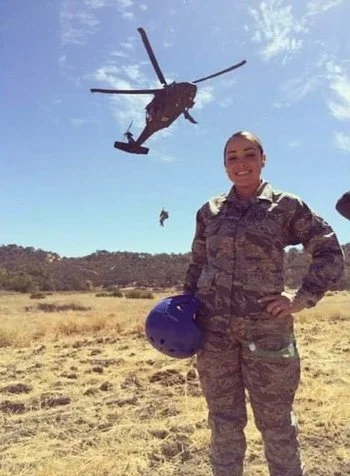
AT NINETEEN, DELIRA UNDERSTOOD SOMETHING WITH BRUTAL CLARITY: IF SHE DIDN’T LEAVE EAST LOS ANGELES, SHE WAS GOING TO DIE.
She'd already survived a drive-by shooting. A drunk driving accident. She was looking for a way out, and the military seemed to offer everything she'd never had — safety, healthcare, a roof that was hers, a path toward something resembling independence.
What she found instead was that she'd brought herself with her.
"It was a facade of safety," Delira told us. "I gained access to things I never had access to, but I still very much struggled with abusing alcohol and getting myself into unsafe situations throughout."
The uniform changed. The patterns didn't.
By 2002, at twenty-two, Delira had met her soon-to-be husband in the military, become pregnant, and married soon after. After the pregnancy, the military told her they required the names of close contacts who would agree to take responsibility for their child if both parents were deployed. Both of her parents were addicts, and she lived thousands of miles away from other family members.
“The First Sergeant said you need to have three people on this list: an immediate person, a short term person, and a long term person. And I thought, well, I don't have any of those.”
Instead, she chose to leave military service and became a civilian spouse in New Jersey with two babies born ten months apart. Postpartum depression and the isolation after both pregnancies felt crippling, and was deeply fueled by her alcoholism. By 2007, a third pregnancy that ended in abortion became a turning point. “It was the first time I recognized that my mental health was not able to support another child.” But things got worse before they got better.
In 2007, Delira finally entered AA and stayed sober for eighteen months. But when her husband deployed a year later, now alone with young children and overwhelmed by responsibilities, she told herself she “deserved” to have a good time. Returning to sobriety would take another decade.
In 2013, Delira returned to work in the military as an aeromedical evacuation technician on cargo planes carrying wounded service members from overseas. Deployed to Andrews Air Force Base, she received service members from Landstuhl, Germany—the final stop before they went home.
"It was really beautiful to be on the last leg of their trip," Delira said. It was also "a very strong alcohol culture."

In 2018, newly separated from her husband, Delira realized she couldn't parent two teenagers while drowning in alcohol. And this time, she made a radical choice: she left aeromedical evacuation entirely because she could not fathom being sober while keeping a role within such a strong “work hard, play hard” drinking culture.
She started looking for spaces that felt different. In AA for the second time, Delira realized the very first place where she felt relief from her craving for alcohol: meditation. She found the California Institute of Integral Studies—a graduate school that, to her surprise, accepted VA education benefits and offered courses on the intersections between meditation, holistic healing, and trauma-informed recovery. She attended classes while holding down a full-time position in the reserves as a First Sergeant, serving as the right hand to the commander.
But sobriety also changed something else. In 2018–19, Delira was sexually harassed by a Chief she worked for. There had been other times in her life when she had been harmed while drinking, experiences she felt unable to report because she carried so much responsibility and shame around her own drinking. This time, she was sober. She knew what was happening, and she decided to report it.
The response was swift. Her promotion was withheld, and after she spoke out about the retaliation, she was also disciplined. What began as a sexual-harassment complaint became increasingly complicated as Delira reported through supervisors, commanders, and civilian and military channels—and had to tell the story again and again.
Eventually, she began having terrifying nightmares about the Chief, the case, and not being believed. One morning, she woke up knowing with absolute clarity: “I cannot tell this story again.”
She wrote to the agencies involved and told them she could no longer continue pursuing the case because of what it was doing to her mental health and sleep. She told them she hoped they would make sure the right people knew what had happened because she believed it would happen again.
Looking back, Delira sees that moment as pivotal. It was one of the first times she remembers truly listening to her dreams and allowing her body to tell her when she had reached her limit.

“The military does not want us to be awake. They want you to be desensitized. They want you to be numb, whether that's through alcohol, or whether that's through bottling your emotions and stuffing them,” she said, “You'll just ignore your body — this thing that's going to be with you through your whole life – and you begin to attach yourself to the military, as if that is the thing that will be with you through your whole life. Both by getting sober and getting an education, I became all the things that the military does not want you to be.”
After deploying to Kuwait in 2022 as a First Sergeant while completing her Master's, Delira returned to a finalized divorce. She moved to Southern California and took up a position as First Sergeant of a Security Forces Squadron, which meant she had 200 military police under her care.
By this point, Delira’s experiences had led her to believe we needed to abolish our current systems of policing. She hoped she could be the right person for her position precisely because she held this different perspective than previous leadership. For two years, she poured herself into the work, working to change a change-resistant culture, while trying to support women in the squadron.
Then a Chief sexually assaulted Delira at an event. He was married. She was single. He had three decades of credibility, while she had only two years in her position. Terrified of not being believed, she stayed silent for weeks.
But this was not her first experience reporting sexual harm from a Chief. Years earlier, she had reached a point where the process itself had become unbearable and had walked away. This time, something was different.
“Thank God I had strong, clear, clarifying women in my life that continually walked through that month with me and got me to a point where I felt like I could report it,” Delira said.
Within five days of reporting the assault, the military expedited Delira to a new base in Georgia. Three days after arriving in her new home, she and her son were in a car accident. Her mental health unraveled shortly after—nightmares, panic attacks, and flashbacks. Almost a year later, in January of 2025, the military declined to pursue the case through the Special Victims’ Counsel process, citing insufficient evidence to establish sexual intent. The only administrative action taken was a Letter of Counseling and the case was closed.

“Despite everything I provided to them – an email in which he admitted what he did, text messages, everything I submitted and told – nothing happened to him.”
The Chief received nothing more than a counseling letter—"a piece of paper that you can shred," Delira said. Six days after the case was dismissed, Donald Trump was inaugurated. Shortly after, she received new orders to expunge all DEI-related materials from her curriculum at work. The rage she felt at these new policies made her realize it was time to finally leave.

“I told myself I’m not going to ignore my body anymore,” Delira said.
After leaving her job, Delira entered a 4-month PTSD treatment program while sober. Her last day in the military was November 30th, 2025. She spent the entire month of December in India on a spiritual sabbatical, and when she returned, the nightmares that had plagued her all year had disappeared.
Now pursuing a PhD in Women’s Spirituality, Delira studies the intersection of trauma, addiction, spirituality, and systemic power. Her work centers how women heal not only from substances, but from violence, institutional betrayal, and the relational systems that shape their lives.
“I started this because I was obsessed with [AA’s] 12 steps of Recovery,” Delira said, “Why do people who heal from something come back and help someone else, and then how does that help them both? I thought constantly about this regenerative feeling that happens when someone comes back to the pain.”
Recently, Delira also sat down with her mother and recorded an interview tracing the ancestral roots of addiction—her grandmother, great grandmother, and the pain that had passed down through generations. Her son helped transform the interview into an audio piece. With her daughter, she is re-voicing the piece and plans to present it at a conference in Montreal.
"My children have been able to look at their own experiences through my addiction, through divorce, through violence," she said. "And then write about it, create around it and have deep conversations, to eventually foster intergenerational healing."
Delira has now been sober for seven and a half years. Asked what message she would want future generations to hear from her experience, Delira's answer came without hesitation:
"Nothing is more powerful than a connected woman. Connected to her own divinity, to her own knowing, to her ancestors, to her children, to her dreams, and connected to her body. Nothing is more powerful.”