
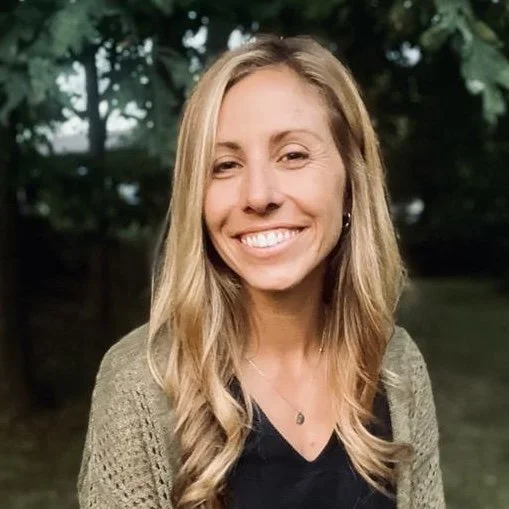
AMY
Middle East, Africa, South Asia, the Caribbean, and Europe
"What I saw was a shared belief. Not in the same theology. But in God. In meaning. In something bigger than chaos."
AMY STARTED AS A PIANIST. Classical training, undergraduate degree, the kind of education that suggested a certain trajectory. But after graduation, Amy spent a year in the Central African Republic, volunteering with missions organizations.
There, Amy met people who dedicated themselves to brokenness without the expectation of a solution. More importantly: people who stayed.
Amy returned to school—a master's in Liberal Studies at the University of Michigan-Dearborn, surrounded by Middle Eastern and Muslim communities. The program was loosely structured, interdisciplinary, self-designed. Amy built her own courses, followed her curiosity.
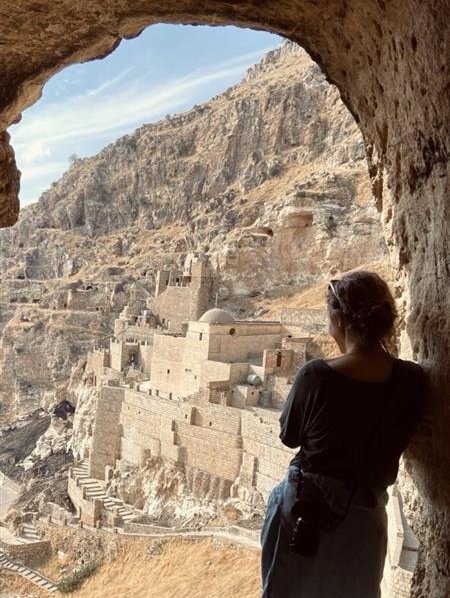
"I didn't know what my role was," she says. "I just knew I wanted to be part of it."
Her first formal humanitarian work was in Uganda. Communications, they called it. What it became was an apprenticeship in listening. Amy traveled between projects, interviewed community members, beneficiaries, local leaders. Amy worked with interpreters, moved across languages and cultures, watched how aid succeeded, how it failed, how complicated everything truly was.
From Uganda: South Sudan. Back to Uganda. Then Greece.
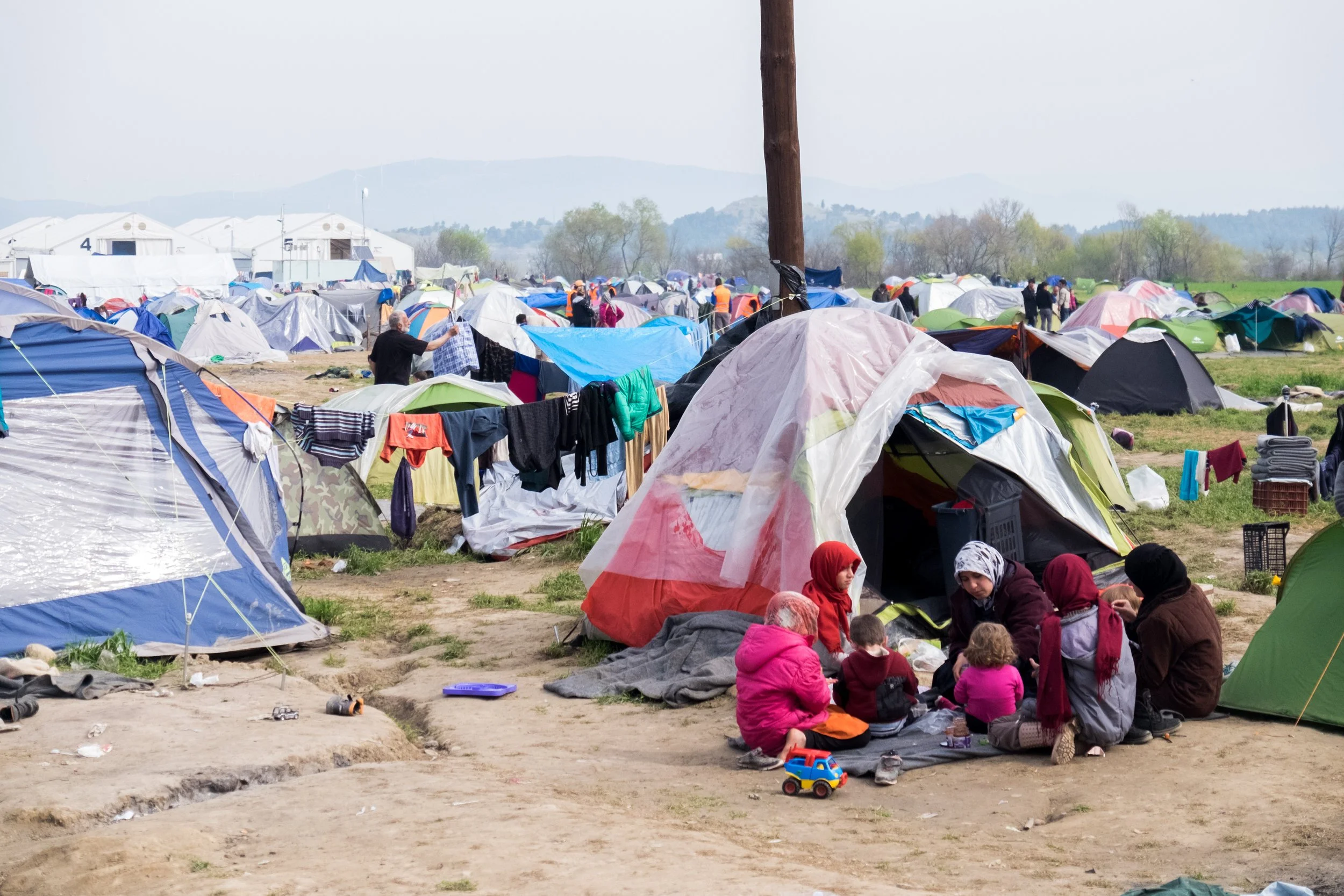
For two years during the peak of the European refugee crisis, the work was walking the camps in Greece, tent to tent, story to story. Afghanistan, Iraq, Syria, Pakistan, Nigeria, Eritrea, Cameroun….
Families who loved their countries. People who didn't want to leave and still dreamt of returning home.
"I didn't understand trauma yet," Amy says. "I just carried their stories."
Amy began working for Samaritan's Purse—a Christian organization operating as one of the largest implementing partners for the UN in Europe at the time. The juxtaposition: A faith-based organization serving primarily Muslim communities, inside a humanitarian system that often wanted religion erased entirely.
"Humanitarian aid is inevitably political," she says, "even if you don't want it to be."
But on the ground, the divide mattered far less than people imagined.
"What I saw was a shared belief," she says. "Not in the same theology. But in God. In meaning. In something bigger than chaos."
Greece was followed by Croatia, South Sudan again, more than a year in Dominica, Barbuda, and then…Iraq.
The Sinjar region, sacred to the Yazidi people. ISIS had carried out genocide there—killing thousands, capturing thousands more, dividing the community in ways that numbers can't convey. Entire towns and villages flattened, burned, destroyed. Ancient structures reduced to rubble.
Amy didn't speak Arabic. The Yazidis, after generations of persecution and a fresh wave of betrayal, had largely stopped speaking it too. They spoke Kurmanji, their own language.
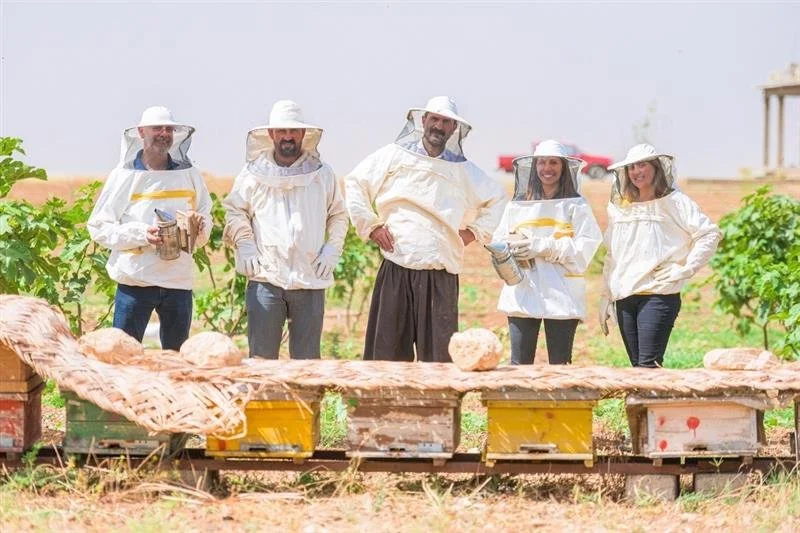
Her team worked to rebuild with local farmers. Beekeeping.
At the base of Sinjar Mountain grows a rare, sacred wildflower believed to exist nowhere else. Bees that feed on it produce a dark, medicinal honey that people travel long distances to buy.
ISIS had burned the hives, trying to make the land uninhabitable for Yazidis.
They were able to bring back the bees. Rebuilt boxes. Watched olive shoots push up from blackened stumps. "It felt symbolic," she says. "The land coming back. The people coming back. Together."
Alongside the livelihoods work, Amy found herself overseeing a growing mental health program. The Yazidis had come home to ruins. Loved ones still missing, neither confirmed dead nor found alive. ISIS released captives in a slow trickle, keeping families in permanent not-knowing.
Amy lived in her own version of uncertainty. Around thirty checkpoints between her compound and the country office. Militias controlling different roads. Evacuations with little warning. She saw a U.S. jet fly over her house the night a high-profile assassination lit up the news. She memorized which routes were passable and which weren't.
In Sinjar, many people were grateful to Americans for helping defeat ISIS. In other areas, resentment ran deep. Nothing was black and white. Several nuances. Multiple layers.
"I cared deeply," she says. "But I knew if I stayed, I would break."
Leaving felt like betrayal. Staying felt like self-destruction.
"It was easier to move to Iraq," she says, "than to move back home."
When Amy returned to the United States, few people understood how to hold what she carried. Amy learned to curate her stories, cherry-picking the beauty and omitting the heartbreak. Amy focused on the generosity, hospitality, and love—which were very real but not all-encapsulating.
The mathematics of witness: what to keep, what to carry, what to set down.
When asked what gives her hope, Amy tells a story from Greece.
Amy once asked a group of Middle Eastern mothers what they were looking forward to in Europe. The women responded: "Amy, we are just surviving. We don't have dreams for ourselves anymore. We only hope our children will be okay."
What inspired her next: these women eventually did want more for themselves.
"Back in the U.S. I'm now working with refugees who are at a place where they're now thinking about their futures and the things they love again," she says, "which was so far from where they were when they were fleeing home. That gives me hope. There is so much beauty to discover in this world, right? They're adding so much beauty to their lives, my life, to our community, and I love that."
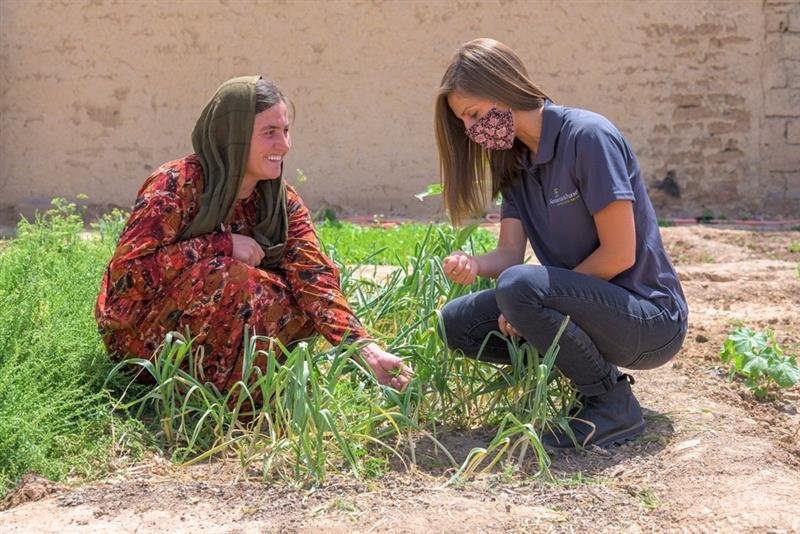
Dreams, picked back up. Slowly.
Now Amy works for World Relief, supporting refugees and immigrants as they build new lives in the United States.
Amy has become fascinated by resilience—what actually helps humans heal. Agency. Community. Strength-based work. Connection to land.
Her experience in Iraq taught her something: people who gardened alongside counselors healed faster than those who only sat in offices. Time in nature can regenerate parts of the brain impacted by trauma.
"When you garden," Amy says, "your skin touches healthy soil, there is a chemical release that's very similar to serotonin. The world is built with ways to heal us, we've just forgotten how to listen."
She thinks often about Sinjar.
About the Nineveh Plains becoming fertile again after destruction. Olive shoots pushing up from blackened stumps. Bees returning to sacred wildflowers. Soil that remembers what once grew there.
What Amy chooses now is shaped by all of it.
She builds spaces where people can remember who they are. Where hands touch earth. Where stories are held without being rushed toward resolution. Where survival slowly makes room for something else.
Dreams, picked back up.
Not all at once. Not without grief.
But together.
Learn more about Amy’s work: